Power managment
Power and communication requirements
Power
OBC - ? V, ? mA, ? W
2 Cameras - ?V, ?mA, ?W
Transceiver - ?
Battery heating - ?
?
Communication
|
CUBESAT PERUN-1p |
|||
|
UHF / VHF TRANSCEIVER |
|||
|
Operations |
Full and half duplex |
|
|
|
Modulation |
GFSK/GMSK |
|
|
|
Frequency Range VHF |
145-146 MHz |
|
|
|
Frequency Range UHF |
430-440 MHz |
|
|
|
Output RF Power |
1W |
|
|
|
Antenna connector |
MCX |
|
|
|
Sensitivity |
-127 dBm at 4,8 kb/s BER 5%, with FEC |
|
|
|
Data rates |
0.1 kb/s to 38.4 kb/s |
|
|
|
Protocol |
AX25 |
|
|
|
Operating temperature |
-40 °C to +85 °C |
|
|
|
Power Supply |
3.3V |
|
|
|
Dimension and weight |
Compatible with cubesat standard |
|
|
|
Other |
RF parameters fully configurable on-orbit |
|
|
Specification of power system
Input from 5 plates, one plate is antenna system.
Solar cell efficiency 29%
Area of solar cell 6*10-3 m2
Area of panel not covered by solar cell 4*10-3 m2
Emissivity solar cell 0.8
Emissivity panel (Al) 0.09
Absorptivity solar cell 0.9
Absorptivity panel (Al) 0.2
Solar insolation 1367 W m-2
Earth insolation 240 W m-2
Perun 1p mass 1.3 kg
Specific heat Perun 1p 800 Wh kg-1K-1
Boltzmann constant 5.6704 *10-8 W m-2K-4
Initial Perun 1p temperature 300 K
Solar cell temperature dependence of efficiency
w = w0(1+dw(T-273-C0))
C0 – 28 C (test temperature for solar cells efficiency)
dw - 2.2 *10-3 %/100/K
blue arrow - x axis; green arrow - y axis; red arrow - z axis
 <--- click for animation
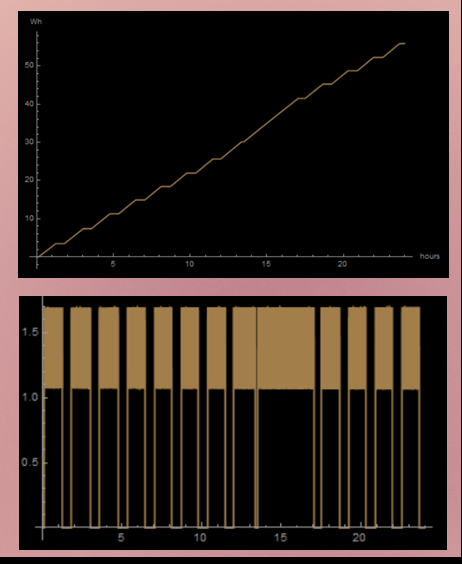
Acquision of energy from the solar panels during one day (upper part of figure), which is correlated with the total insolation on the sides of Perun 1p(bottom part of figure). Acquisition of energy follows the time when Perun 1p is exposed to Sun and when it is not. It is interesting that in one interval Perun 1p is exposed to Sun for a much longer period than the expected interchange lasting 45 minutes.
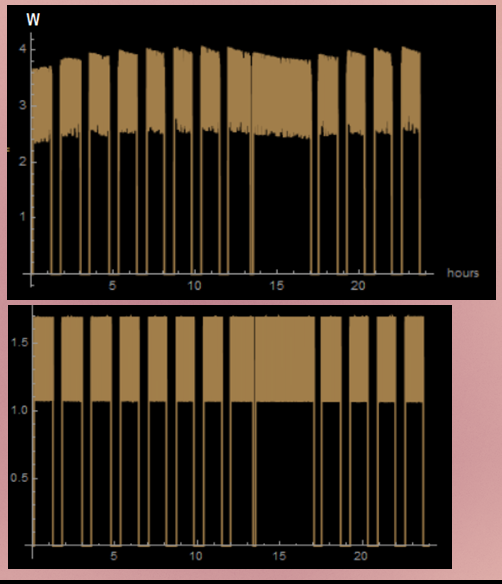
Power from the solar panels during one day (upper part of figure), which is correlated with the total insolation on the sides of Perun 1p(bottom part of figure). Power follows the time when Perun 1p is exposed to Sun and when it is not. Oscillations of power is due to the change in temperature of the solar panels.
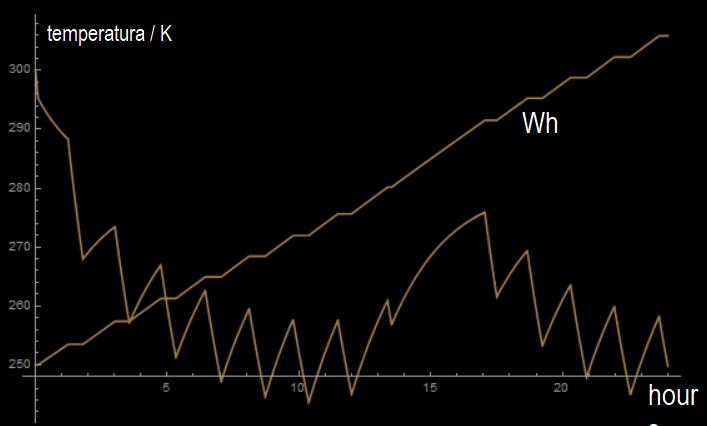
Temperature of Perun 1p under the assumption that Perun 1p is cube of average heat capacity and mass. Absrption of Solar radiation is determined by the parameters of solar cells and base pannels. Cooling is due to radiation law, again with the parameters of the solar cells and base pannels.